As Artificial Intelligence (AI) has transformed industries faster than ever, accounting is no exception. AI in accounting automation has become more efficient by performing routine tasks effectively. But the biggest question remains: will AI replace accountants, or will it only change their working methods?
This article will explain the future of accountants with AI, or will AI take over accounting jobs?
Understanding AI in Accounting Automation
AI tools are now handling tasks that once took hours in just minutes. Through AI in accounting automation, software can:
- Process invoices automatically
- Categorize expenses
- Reconcile transactions
- Detect errors and fraud patterns.
- Generate financial reports
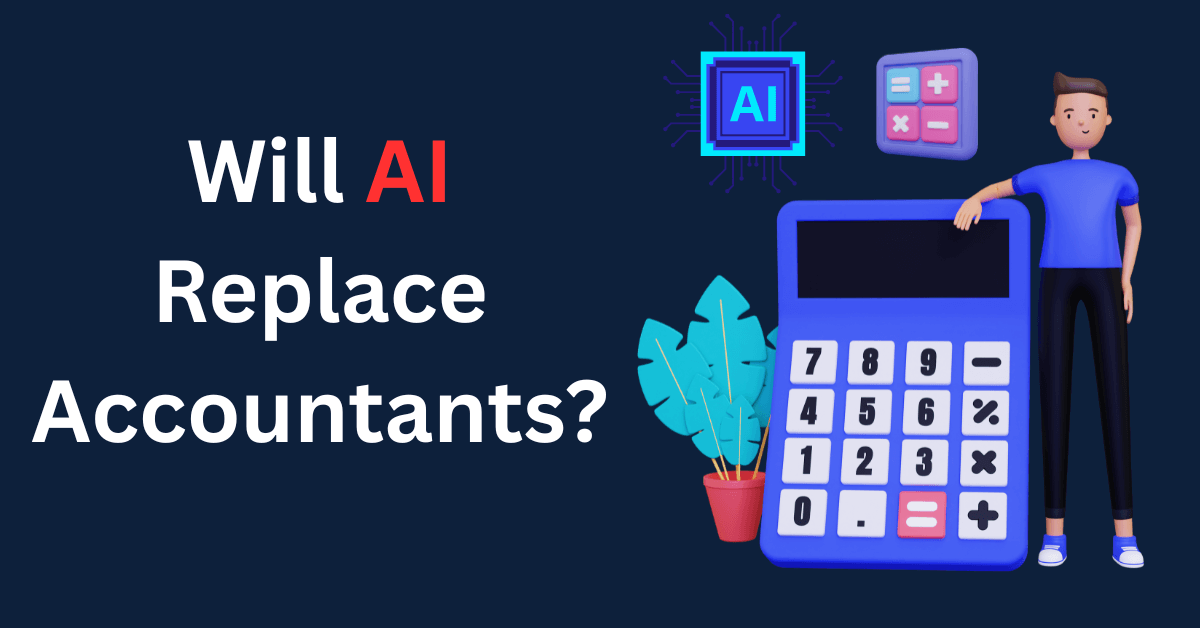
This technology eliminates labor-intensive processes, increases the precision of the output, and reduces the time consumed.
Examples of AI Accounting Tools
Some popular tools used today include:
- QuickBooks AI: Automates bookkeeping and expense tracking.
- Xero Analytics Plus: Offers predictive financial insights.
- KPMG Clara: Uses machine learning for audit analysis.
- Blackline: streamlines financial close and account reconciliation.
These platforms show how artificial intelligence in financial management is becoming the new standard.
The Future of Accountants with AI
AI can take up the monotonous accounting processes, but it cannot completely substitute the human judgment, ethics, and decision-making that come along with accountants.
The future with AI will not be a battle but rather a good partnership for accountants. AI will handle the data entry part, while the accountants will be:
- Interpret AI-generated insights
- Advise clients on financial strategy.
- Ensure compliance with laws and regulations.
- Manage ethical decisions AI cannot make
Real life Example:
A medium-sized accounting firm in the UK has just incorporated the use of an AI-driven bookkeeping application. After a period of three months, the data-entry duration was shortened by 60% and the accountants were able to spend more time giving advice to clients. The firm did not eliminate employees, rather AI had made the entire team more efficient and produced better results.
New Roles Emerging
As automation grows, new roles are also emerging, such as:
- AI Data Analyst for Finance
- Financial Technology Consultant
- Audit Data Scientist
- Compliance Automation Specialist
Artificial Intelligence in Financial Management
Better Decision-Making
AI systems can examine vast datasets in seconds. This helps businesses to make decisions faster and more accurately.
For instance:
- AI predicts cash flow patterns
- Detects fraudulent activity before it happens
- Monitors market trends to guide investment choices
This capability allows accountants to focus on financial strategy and forecasting, not just report preparation.
Efficiency and Accuracy
AI has a significant impact by lessening the chances of human error occasioned by calculations and data entry. It simulates human interaction by learning from past mistakes and upgrading itself as a result.
Consequently, the whole process turns out to be more efficient and cleaner, and reports remain credible. This is all significant to the general practice of financial management.
Will AI Take Over Accounting Jobs?
AI might replace some routine accounting roles, such as repetitive or rule-based rules.
Examples include:
- Data entry clerks
- Junior bookkeepers
- Invoice processing staff
But again, an AI machine is still far from a human being in emotional intelligence, skepticism, and critical thinking. These are the main attributes of an accountant.
Therefore, AI won’t be the reason for job loss, but it will change their nature. The accountants who will equip themselves with the necessary skills for AI-operated tools and the ability will surely be the most sought-after.
The Human Edge in Accounting
No doubt, AI is a powerful tool and has open-ended possibilities, but it cannot take away human roles completely. It is the human that decides based on:
Ethical oversight: Transparency and honesty are the main values.
Strategic advice: Giving direction in navigating difficult financial situations is a great help.
Relationship management: Creating a bond of trust with clients and other parties is a great asset.
An algorithm cannot achieve human insight in terms of business needs, feelings, and overall plans.
Preparing for the AI-Driven Future
Accountants should not just wait for the future to knock on their doors, but rather be prepared for it:
- Acquire knowledge of AI and data analytics tools.
- Machine learning basics need to be understood.
- A strategic mindset and solving problems should be the main focus.
- Build up communication as well as advisory skills.
Through the combination of traditional accounting expertise and contemporary AI knowledge, the professionals can hold their positions in the future workforce.
Benefits of Using AI in Accounting
1. Time Efficiency
AI handles repetitive work, enabling accountants to focus on more valuable tasks.
2. Reduced Errors
Automated systems lower the chances of manual mistakes.
3. Cost Savings
Automation cuts down labor costs and increases productivity.
4. Real-Time Insights
AI tools deliver up-to-date financial data for quick decisions.
5. Enhanced Compliance
AI systems help track changing tax laws and regulations, ensuring accuracy.
Limitations of AI in Accounting
Despite the benefits, there are challenges:
- High setup costs for AI systems
- Data privacy risks if not managed properly
- Lack of flexibility in understanding unique business contexts
- Job transitions that may affect entry-level accountants
FAQs
1. What jobs will AI actually replace?
AI will take over jobs that involve a lot of repetition, like data input, processing of invoices, and everyday bookkeeping. But still, the areas of accounting that involve analysis, advisory, and strategic decision-making will call for human professional input.
2. Are accountants going to be around in 10 years?
Definitely, but their functions will change. With AI backing, the accountants will spend their time on analysis, strategy, and decision-making instead of handling the data manually.
3. What jobs will be safe from AI’s advances?
Mostly the ones that require artists, human-like judgment, and people with emotional intelligence; such jobs as auditors, financial advisers, and consultants will not disappear entirely due to AI.
4. Will AI take over ACCA?
No way. AI cannot substitute for professional qualifications like ACCA. In contrast, it raises the status of ACCA accountants by doing monotonous work and speeding up the process further.
Conclusion
In the end, AI will replace accountants completely; rather, it will take care of the unchallenging activities. However, people will still be needed in the areas of ethics, analysis, and strategy. In the future, those accountants who upgrade their skills, learn new things, and partner with AI, turn technology from a threat into an opportunity. AI won’t drive the industry away, it will make the industry better.
REFERENCES:
https://dl.acm.org/doi/abs/10.1145/3364335.3364345
https://link.springer.com/chapter/10.1007/978-3-031-17746-0_51