In today’s progressive digitalized market, the trend of artificial intelligence is going up day by day. Everything gains momentum due to the speedy knowledge of AI sources. Everything changes in a second, not requiring a long time span. From businesses to healthcare sectors, seemingly impossible sales become possible. According to research, in 2026, about 85% of businesses will adopt AI in their digital marketing to scale up sales.
You always hear about machine learning and deep learning, and at the same time, when you are dealing with the field of AI. But both terms are different in scope, challenges, and opportunities. In this article, we learn all about the deep learning scope and figure out what potential it holds.
What is Deep Learning?
Deep learning is a branch of machine learning that uses neural network models to process large datasets and make decisions like the human brain does. For training purposes, a large amount of datasets are fed into the algorithm’s history. The main purpose of deep learning is to enhance the computer’s ability to learn from past datasets and make decisions for future activities.
Deep learning is a very smart way to make an algorithm think like a human being’s mind. As you know, the human mind thinks through its senses, like viewing the images, reading the text, and recognizing the speech. These are all things that are analyzed by multiple sensory organs and by the brain’s neural network.
Similarly, an artificial neural network operates similarly. They transmit the data from one place to another through multiple neural networks. Many layers of nodes are interconnected and transfer the data speedily.
How Deep Learning Changes the Future? Spreading Powerful Impact Everywhere:
Deep learning holds impact on the world of artificial intelligence. It enables the machine to learn from a large amount of data and make smart decisions easily. Day by day, as the technology continues to advance, deep learning is grounding its feet in the tech world. It is thriving the scales up for all businesses and entire industries. It also unlocks more as follows:
1. Making Technology Smarter Day by Day:
Technology becomes smarter due to deep learning. All AI systems use deep learning. This makes the tech world smart and improves the user behaviour. In the future, these systems will give accurate results and enhance the productivity of all businesses.
2. Unlock Many Career Opportunities:
The hype of deep learning creates many opportunities in the AI industries, such as AI engineering, data science, robotics, and computer vision. Students and professionals who learn deep learning skills have a strong edge in the job market.
3. Making Improvements in the Healthcare Sector:
Deep learning helps doctors detect diseases in a very quick test due to deep learning resources. AI systems can analyze medical images, and they suggest different treatments according to your health report. It reduces the health risk and improves patient health without booking any appointments for days.
4. Setting Automation Smoother:
Deep learning is setting many industries to automate all complex tasks into simpler ones. Dealing with the manufacturing sector in finance, all businesses can analyze large datasets in just a single click. It reduces human error ultimately and increases productivity.
5. Bringing Innovation in the Transportation Sector:
All transport sectors that deal with automated vehicle industries are mainly dependent on deep learning. In the future, these technologies that have a touch of deep learning will make transportation safer and easier. Ultimately, it generated vehicles that are less dependent on humans.
How the Future of Deep Learning Differs from Machine Learning :
Machine learning and deep learning are the most frequently used terms in the digital era. AI is designed to solve many problems as humans do. Additionally, machine learning uses historical statistical datasets to train computer algorithms. So, in this way, it makes independent predictions and decisions based on these past activities when a user takes a new action.
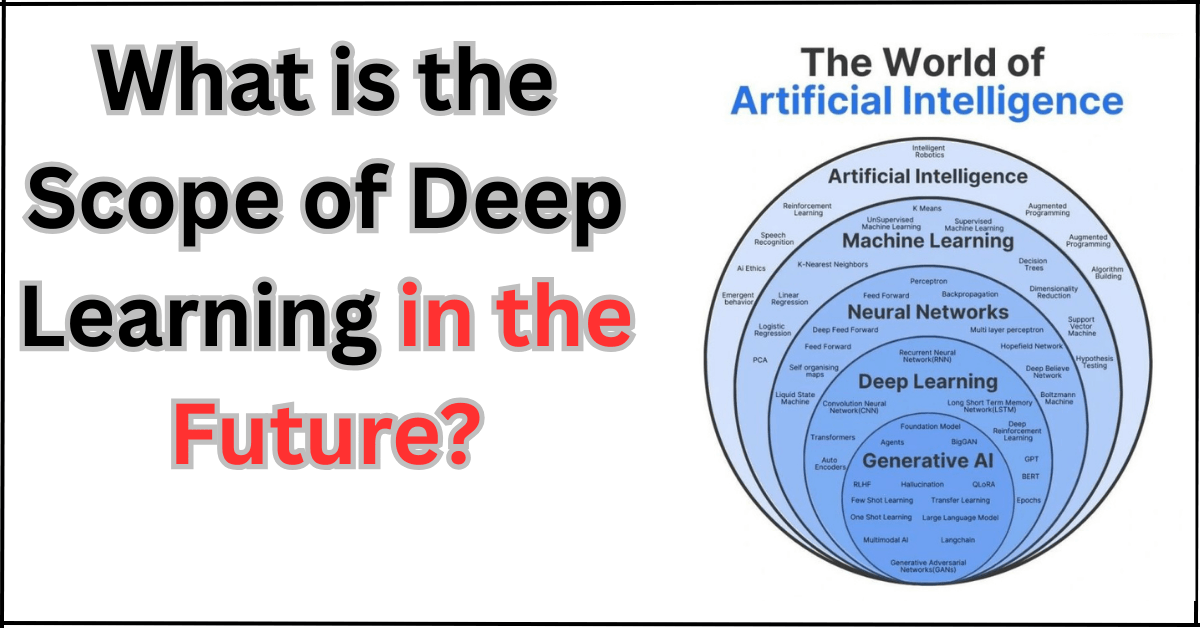
In fact, deep learning is also a subset of machine learning and artificial intelligence. It depends on specific artificial neural networks because it is specific to their trained algorithms. It is used to understand texts and images for natural language processing and computer-based algorithms that process large datasets in bulk.
Deep Learning Vs. Machine Learning:
| Basis of comparison | Deep learning | Machine learning |
| Definition | A specialized part of machine learning that uses a deep neural network to learn patterns by using large datasets. | A subset of AI that allows machines to learn from data and make predictions without being explicitly programmed |
| Data requirement | It requires very large datasets to perform well. | It requires small to medium datasets to perform well. |
| Feature engineering | It automatically learns features from raw data. | It needs manual feature extraction by humans. |
| Training time | It takes longer training time due to complex neural networks. | It usually takes less time to train. |
| Hardware requirements | It often requires powerful GPUs or specialized hardware. | It can run on standard CPUs. |
| Complexity | It deals with complex neural networks with many hidden layers | It deals with simpler models such as decision trees, regression, and SVM. |
| Performance on complex data | It consists of excellent performance with unstructured data like images, speech, and text. | It is limited to performance with images, audio, and video. |
| Examples of Algorithms |
|
|
| Applications | The applications of deep learning is self-driving cars, image recognition, speech recognition, and chatbots. | The applications of spam detection, recommendation systems, and fraud detection. |
Deep Learning Applications in Future Industries:
The scope of machine learning becomes crystal clear when you examine deep learning applications in future industries.
Healthcare Revolution:
The impact of deep learning in healthcare and finance is at an all-time high. In healthcare, machine learning models are helping doctors to diagnose diseases without any invasive procedures. It gives you accurate results. The future of deep learning in healthcare promises faster results and reduced errors. AI-powered robotic surgeries can diagnose many diseases and recommend surgery. And predictive health monitoring systems that support early diagnosis reports before crossing the danger zone.
Financial Transformation:
The finance sector is one of the largest industries that embraces deep learning and invests aggressively in it. Fraud detection systems are becoming easier to use, and their results save time in detecting errors. Algorithmic trading is getting smarter. Risk analysis models are becoming more predictive.
Education and Personalized Learning:
Education is really turning its curve when AI hits the ground. At first, for every student, searching for files and reliable content that holds authenticity in their own. Nowadays, AI tutors are available online with just one click. It is making it easier for students to learn. Learning platforms will customize content in real-time.
Robotics:
Robotics is deepening its roots in every industry. Robots are machines that rely entirely on algorithms. They serve food to customers’ tables as waiters in restaurants. They are so highly trained that they give you a customized haircut. Robots hit different in factories for product assembly and in specialized surgeries. Improvement in technology. As technology improves, robots are becoming smarter and more helpful in daily life.
Computational Quantum:
Quantum computing is an advanced field that uses the principles of quantum mechanics to process information through coding. When combined with machine learning, it creates powerful possibilities for generating predictions, and experiments can be performed using these analyses, known as Quantum Machine Learning (QML). As research grows, new career opportunities in quantum algorithms will also expand.
Challenges of Deep Learning in the Future 2026:
Deep learning is growing rapidly. But its future brings several important challenges and limitations that must be carefully addressed.
Data Privacy and Security:
Deep learning systems handle massive datasets, including personal data. Protecting data privacy is very important. As the system drops out due to phishing attacks, all data may be misused.
Bias and Fairness:
If training data contains bias, DL models can produce unfair or discriminatory results that contain a lot of error. Ensuring fairness and ethical AI will remain a challenge, as it involves how to manage all data in one place with high security.
High Computational Costs:
Advanced models require powerful hardware and substantial energy to handle the large amount of data. These energy expenses rise and cause the budget to go out sometimes. But when you handle the cost, the results are unpredictable.
Lack of Transparency (Black Box Problem):
Many models are very difficult to deal with. Making systems more productive and trustworthy, catching their algorithm and working is very necessary.
Data Quality Issues:
Most of the time, you find the data is incomplete or poor. It can reduce the model accuracy. When you feed high-quality data into the algorithm, it gives you accurate results eventually.
Fixing the Security Threat:
Deep learning algorithms can be manipulated easily by hackers by feeding misleading data. They easily steal personal information from websites. Putting a strong security setup can save you from further attacks.
FAQ’s:
What is the fastest way of upscaling with deep learning?
The fastest way of upscaling with deep learning is by using high-quality datasets, powerful computing systems, and well-designed neural network architectures.
What are the basic skills a beginner needs to pursue deep learning?
The basic skills a beginner needs to pursue deep learning include programming (especially Python), mathematics such as linear algebra, and statistics.
What are the biggest obstacles deep learning faces in the future?
The biggest obstacle to deep learning in the future is large datasets with high computational cost. A large training time is needed, and model interpretability.
How does deep learning future thrive day by day?
Deep learning’s future thrives day by day because it promises every industry innovations. It is scaling up the business to new heights, where they think it is impossible.
Conclusion:
The future of deep learning is like deep roots in the ground that do not show their growth eventually, but it can be seen by the passage of time. Actually, it is shifting industries towards innovation. From healthcare to quantum computing sectors, its scope continues to expand rapidly. Smart systems are becoming smarter and faster day by day. Although the challenges of data manipulation go hand in hand, they can also be overcome easily. If you choose to upskill and adapt this machine learning career, you can become part of this transformation
Reference Link:
https://www.statista.com/serp?q=artificial+intelligence+adoption
https://www.sciencedirect.com/science/article/abs/pii/S0720048X19300919
https://agupubs.onlinelibrary.wiley.com/doi/full/10.1029/2021RG000742