Machine learning models do not magically become smart overnight. Every accurate prediction and clever recommendation relies on a series of fine-tuned decisions, and that’s where hyperparameters step into the limelight. If you love to train a model and wonder why changing one minor tweak abruptly boosted your performance, you have already brushed against the power of hyperparameters.
In simple words, hyperparameters guide you on how a model learns, how fast it learn in small settings, and how well it performs. Understanding all these factors makes you an expert, just like the driver of a vehicle, who knows how to ride it rather than controlling the speed. In this article, we learn what hyperparameters are, why tuning them is important, and the techniques for tuning these parameters.
Hyperparameters in Machine Learning: Deep Explained
Hyperparameters in machine learning are configuration settings that are defined by default in software before training begins. They are not learned from data; instead, you choose them to shape how the learning process goes beyond. It easily beat the rules of the game, rather than the score itself.
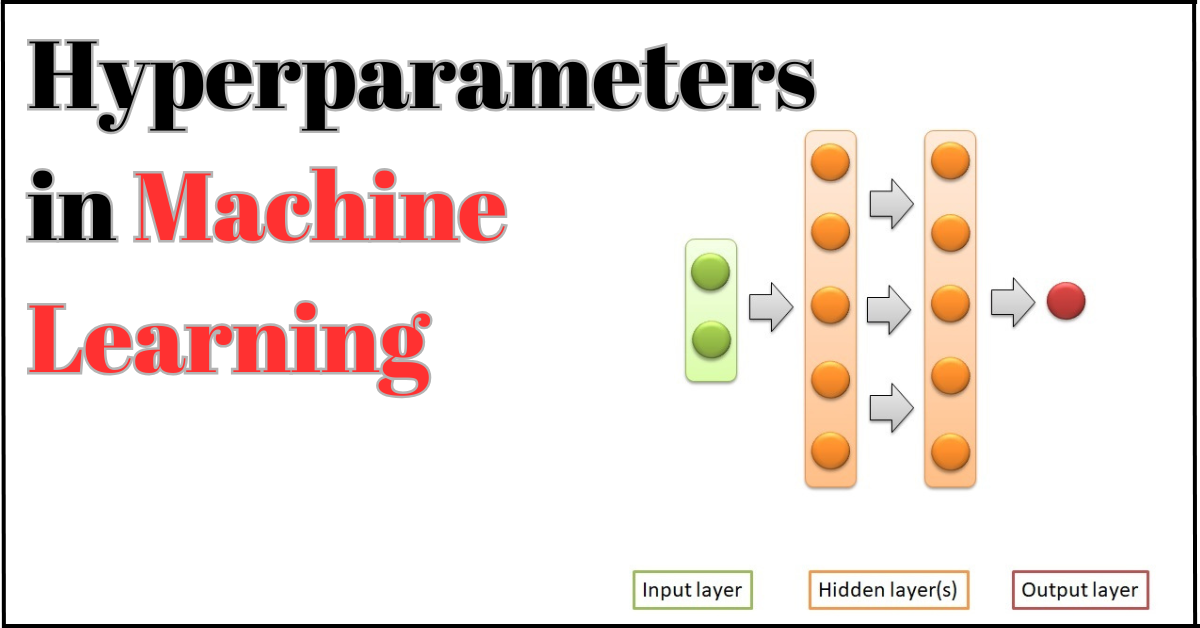
For example, how many layers a neural network should have or how fast a model updates its weights are hyperparameter decisions, which take this performance decision in a minute.
A single hyperparameter example can dramatically tweak your results. It turned your average model into a high-performing one or vice versa.
Unlike parameters, which are learned during training, model hyperparameters remain fixed as default settings. It only changes when you change them. That’s why when you understand them, you easily align your lower-level model with the upper-level model. But when you ignore them, your model may get stuck and never reach its true potential.
Parameter Vs. Hyperparameter: Are they the same or not?
Parameters are the variables that are used and changed continually during training your model to find the best setting fit for your data. Parameters and hyperparameters are two sides of the image. You cannot understand one fully without the other. Imagine hyperparameters are the routes in the machine learning journey, and parameters are the riding drivers that know how to ride on those routes. In fact, hyperparameters control how a model learns during each execution, while parameters are what it learns during training.
How Hyperparameters Influence the Shape of Parameters:
Hyperparameters influence parameters step by step in a very effective manner:
- Increases the learning rate to decide how big each update to a parameter can be set quickly.
- The number of epochs decides how many times the parameters are updated.
- Batch size controls how frequently parameters change.
- Regularization strength limits how significant parameters can grow.
- Model-complexity hyperparameters determine how many parameters the model has in the first place.
So, hyperparameters do not just assist parameters; they govern how to act when data is launched.
Common Types of Model Hyperparameters:
There are many algorithms that rely on hyperparameters, but there are few familiar categories in which they fall.
Learning Rate Hyperparameters:
The learning rate controls how big a step you take when hyperparameters are set apart. To reduce errors, you have to set hyperparameters very accurately by default.
When you set values too high, the chance of overshooting the model increases.
But when you set the values very small, training becomes very slow, like a turtle. So, choosing the right hyperparameter is very important first. Because when you decide, parameters come into play on the road. This is one of the most critical model hyperparameters you will ever tune.
Model Complexity Hyperparameters:
These models tell you how complex you choose the hyperparameters of your model.
A practical hyperparameter example that tells how :
1: The depth of a decision tree tells how far the decision tree extends its tips.
2: The number of hidden layers in a neural network.
3: The number of neurons per layer.
If the decision tree depth goes too deep, it will overfit the parameters. But if it goes too shallow, it will lead to underlifting.
Regularization Hyperparameters:
Regularization hyperparameters help you control overfitting variables by penalizing overly complex models. Parameters like L1 and L2 regularization are applied to a model, which becomes the strength of a model and acts like guardrails. It also saves your model from memorizing noise.
Popular Algorithms Where Hyperparameters Are Used.
All algorithms did not use the same hyperparameters. Every variable setting of a model is different for every data set you enter during your machine learning journey. Therefore, choosing the correct algorithm with the correct hyperparameters is a great combo.
- Linear Regression is used to control the regularization strength.
- Decision Trees are used to determine the maximum depth and the minimum number of samples per leaf in a data set.
- Random Forests are used to determine the number of trees and the maximum number of features for the test data set.
- Support Vector Machines are used for classification and regression in high-dimensional tasks such as separating data and image recognition. The algorithm that offered these specifications is Kernel type, C value, and gamma.
Neural Networks are used to learn the learning rate, batch size, and number of epochs for a dataset.
What Is Hyperparameter Tuning in Machine Learning?
Hyperparameter tuning in machine learning is the process of analyzing datasets and systematically searching for the best hyperparameter values to optimize model performance. Instead of guessing, you experiment with the data, evaluate the results, and refine the model’s actions.
This process is very important because no single set of hyperparameters fits all the problems. As you know, the correct configuration depends on:
- Dataset and quality.
- Feature complexity.
- Algorithm choice.
In essence, tuning is where theoretical data meets practical performance. It is the art of turning raw models into polished performer models.
Popular Hyperparameter Tuning Techniques:
Grid Search:
Grid search tries every possible combination of hyperparameters within a defined range. While thorough, it can be painfully slow for large models. Still, it’s a classic approach to hyperparameter tuning in machine learning.
Random Search:
Instead of checking all data values, random sampling is used to evaluate hyperparameter combinations. Wonderfully, it often finds better solutions faster, especially when only a few parameters truly matter.
Bayesian Optimization:
This more innovative approach uses past outcomes to decide what to try next. It is most often an efficient and elegant technique for tuning the hyperparameters of complex models.
Automated Tuning (AutoML):
AutoML tools are usually used to automate hyperparameter tuning in machine learning. This tool always makes it easy for those who are not very expert in tuning the great fit data. They may save time, but they may also hide essential learning opportunities.
Hyperband:
This tool improves on the random search algorithm by allocating resources intelligently through early stoppage. This type of technique stops poor-performing models early. It usually prioritizes the configuration that produces the strongest results in each iteration.
Challenges in Hyperparameter Tuning:
Despite its importance, hyperparameter tuning in machine learning is not easy for every model. The parameter that applies to one model is not valid for all. It can be most challenging due to:
- Computationally expensive.
- Time-Consuming.
- Confusing for many beginner tuners.
The hardest part? Which hyperparameters matter the most? Not all of them deserve equal attention, but tuning everything at once can lead to zero return.
FAQ’s:
What is the difference between parameters and hyperparameters?
Parameters are the experimental data learned during training, whereas hyperparameters are the variable settings applied before training and control how learning actually happens.
What is the hardest part of machine learning?
The hardest part of machine learning is balancing theory with practice. Understanding the algorithms and effectively preparing them with proper data is really a messy task. But handling it is really a master level skill.
Which hyperparameters are most essential to tune?
The most essential hyperparameters to tune are the learning rate, model complexity, and regularization strength. Model hyperparameters have the most significant impact on performance across most algorithms.
Conclusion:
Hyperparameters are the real heroes in the journey to machine learning success. They silently dictate how well your model learns from the data analysis, adapts to the data processing, and performs effectively in the real world. From a single hyperparameter, like the learning rate, to advanced strategies for hyperparameter tuning in machine learning, every choice you make shapes your final results. While tuning gives you cringy vibes at first, it is also where true mastery begins. Deeply understand your model hyperparameters, measure their influence, and treat tuning as both a science and an art. You will not just build models; you will create models that matter.
Reference Link: