Have you ever noticed why Netflix knows how Google recognizes your voice instantly? You just see your craving answer popping in front of you. But do you know why it is very accurate and to the point when you type a question? So, the real question is what empowers it. If you are entering the world of AI, you might guess the answer is deep learning.
You do not want to waste time learning the wrong skill. You want clarity. You want direction. You just want to know whether deep learning is truly necessary or just hype. In this article, you will clearly understand the importance of deep learning in data science. The role of deep learning in data science is really a big deal. And how it connects with machine learning and artificial intelligence is an art that paints the whole picture.
The Ultimate Power of Deep Learning in Data Science.
When people search for deep learning in data science, they usually want one simple answer. Deep learning is a set of machine learning techniques that depends solely on neural networks to analyze complex data. It works specifically with unstructured data like images, audio, and text.
In data science, you deal with data. Lots of it. Some of it is clean and structured. Some of it is messy and unorganized. Deep learning spreads its light when the data becomes huge and complex. If you really want systems that can recognize faces, translate languages, or detect fraud patterns, deep learning is the powerful key.
Importance of Deep Learning in Data Science.
Now, let’s talk clearly about the importance of deep learning in data science. Why does it matter? Because data today is massive. It is complex. It is unstructured. You see deep learning used in Healthcare diagnostics, Fraud detection systems, Recommendation engines, and image recognition. Traditional machine learning models sometimes struggle with huge datasets and complex patterns. Deep learning handles them better. If you want to work on digital projects, deep learning gives you a competitive edge over all dynamic projects..
Deep Learning is the Shining Sky of Data Science Projects.
In today’s world, deep learning in data science is very crucial. It is not always required in the domain field. But it becomes critical in specific situations. You use deep learning when the data is very large. The data includes images, text, or audio. Accuracy is very extremely important when you want automation at scale.
For example, neural networks in data science help build chatbots, detect cancer from scans, and analyze customer sentiment. But here is something important: not every project needs deep learning. Sometimes simpler machine learning models are faster and more efficient. You must choose based on the problem, not the trend.
Neural Networks are the key to Data Science.
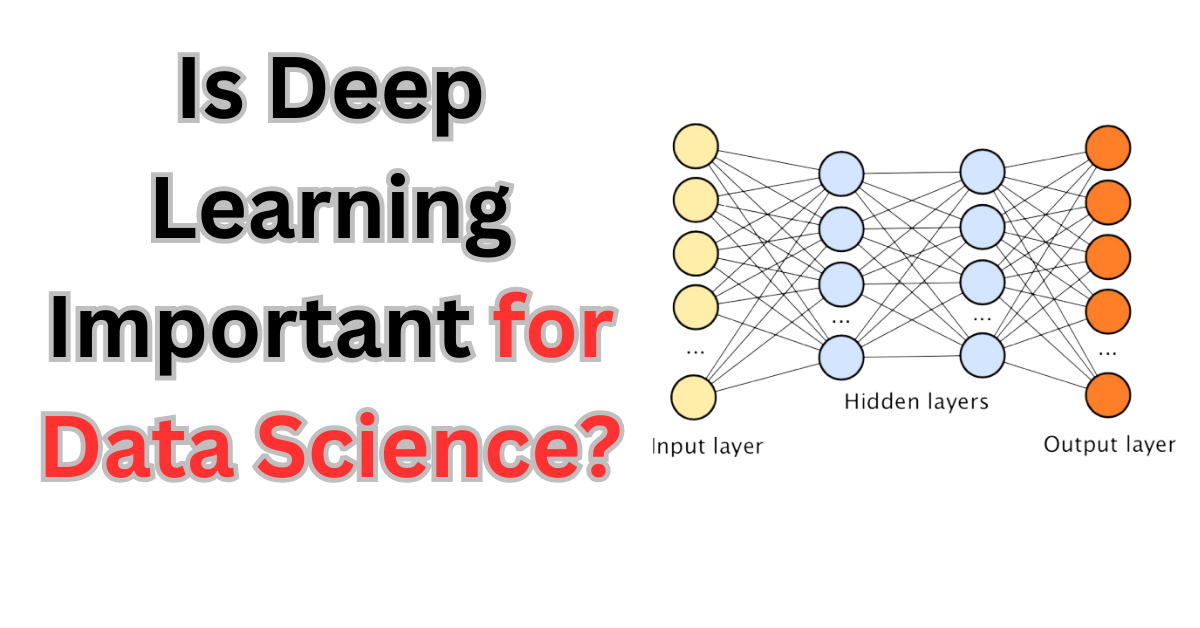
At the heart of deep learning are neural networks in data science. These networks mimic how the human brain processes information. They consist of layers that extract patterns step by step. You benefit from neural networks when patterns are hidden, relationships are complex, and data is high-dimensional. If you want to move into advanced AI roles, understanding neural networks is a must; you have to unlock it.
Comparison of Artificial Intelligence with Data Science.
Artificial Intelligence is really a deep concept that has its roots of data science. It tells how data science focuses on gaining insights from data. Machine learning helps models learn from data. Deep learning enhances this learning using deep neural networks. Deep learning solely focuses on AI systems with their wider domain of impact. It also enables automation, personalization, and intelligent decision-making. When you have a strong grip on deep learning, you build intelligent solutions that solve the crux of the matter.
Pros of Deep Learning:
- Feature Engineering Learning: Deep learning models simultaneously learn features from multiple data sources during the manipulation tasks. It actually eliminates the need for manual feature extraction. This capability enables them to handle a wide range of data types and complex structures only.
- High Result Performance: Deep learning models achieve high result performance in many tasks. It outperforms traditional machine learning algorithms in accuracy and efficiency. This particularly enables you in image recognition and language processing tasks.
- Multi-tasking in every field: Deep learning algorithms are used in almost every field by handling huge amounts of data and computational power available. As more data becomes available, these models continue to improve, adapt, and lead to better performance.
Challenges of Deep Learning:
Massive data requirements: Deep learning requires massive datasets to manipulate. Without enough quality data, the model underperforms or overfits. Collecting and cleaning data is expensive and data-consuming.
High Computational Cost: Training deep neural networks requires powerful GPUs or TPUs. This means expensive hardware, high electricity costs, or long training time.
Overfitting Risk: Complex neural networks can memorize data rather than learn patterns, especially with small datasets.
FAQ’s:
What exactly does a data scientist know about deep learning?
A data scientist must know the strong foundation of neural networks, popular deep learning architectures, frameworks, and tools.
How often do data scientist jobs require data scientists to develop machine learning models from scratch?
Most data scientists do not build machine learning models from scratch very often. Most of the time, it depends on the company, role, and industry.
Which ML models do I need to know to become a good data scientist?
If you really want to become a good data scientist, always master Linear and Logistic Regression, Decision Tree, Random Forest, Support Vector Machines, and Naive Bayes. Most importantly, understand advanced neural networks using TensorFlow or PyTorch.
How much machine learning is needed to become a data scientist?
You do not need to invent the algorithms, but you must understand how models work, when to apply them, and how to tune and deploy them effectively in real-world business problems. To become a data scientist, you just need a solid command of supervised and unsupervised learning.
Is TensorFlow only for deep learning?
No, TensorFlow is not only for deep learning. In fact, it is widely used for neural networks and deep learning tasks. It also supports traditional machine learning, model deployment, and production pipelines.
Conclusion:
Deep Learning is really important for data science when you do it strategically. You start with machine learning. You build your foundation. As you move toward deep learning, the problems become more complex. Deep learning in data science continues to grow with the passage of time because data keeps expanding in size and complexity. When you hit up neural networks in data science, you solve challenges with a single go that traditional models cannot solve.
Reference Link:
https://link.springer.com/article/10.1007/s00530-020-00694-1
https://link.springer.com/chapter/10.1007/978-1-4899-7641-3_12
https://link.springer.com/chapter/10.1007/978-3-030-36841-8_20