Everyone is searching for an expert who can tell them the right amount of protein in their diet. They also dictate the best resources to get the desired amount of protein in their diet. But unfortunately, I do not get an expert who fits in their shoes. They are not only searching for food but for solutions that are sustainable, ethical, and scalable.
That is the turning point at which the booming “alt-protein” industry steps in. From lab-grown meat to plant-based eggs, scientists are working around the clock to create delicious alternatives that do not cost the earth. But here a question arises: ” How exactly is Artificial Intelligence (AI) empowering this radical shift?”
Imagine you have a gadget that speeds up R&D cycles, predicts consumer taste profiles, optimizes fermentation, and enhances texture at any expert’s fees. AI makes itself the expert who makes this possible. It crunches massive data sets. It models biological behavior. It simulates food structures long before a product hits the factory floor. And yes, it saves time. Lots of it.
In this article, we will learn how AI shifts human dependence from food to tools. We become experts on how AI decides ingredient discovery, improves flavor and texture, enhances nutrition, boosts scalability, and shapes the alt-protein future.
AI Used in Alt-Protein Production? – Well Explained
Alt-proteins are basically alternative protein resources compared to traditional animal-derived protein sources. They are made from plant-based meat. Precision-fermented dairy algae proteins, fungal mycoprotein, and cultured (cell-based) meat are included when they are grown to produce fully nutritious proteins.
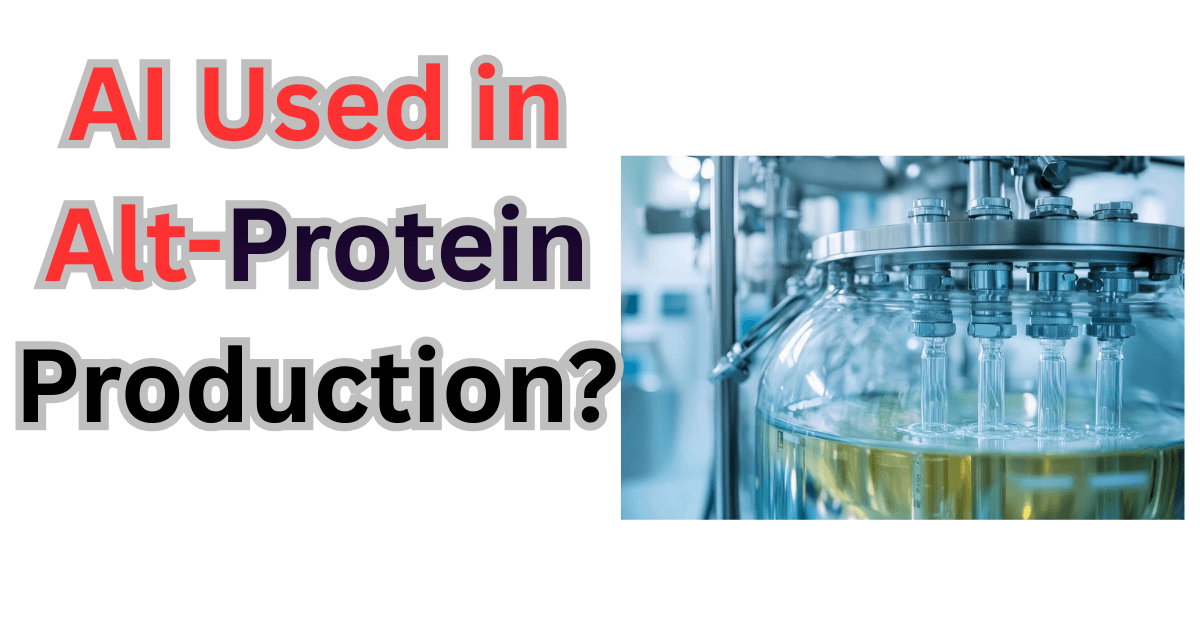
The Alt protein helps reduce environmental impact. Cut greenhouse gas emissions, and end factory farming to some extent. And still satisfy taste buds. On the other hand, developing an alt-protein is no walk in the park. Traditional trial-and-error R&D is slow, and it costs more for the industry. And sometimes it proves to be painfully inefficient. But, AI steps in as a hero on the war front.
Discovering the Ingredient:
Alt-protein relies on ingredients that resonate with animal properties, such as chewiness, elasticity, marbling, and aroma. Finding such ingredients manually is like searching for a person without knowing their name.
AI changes the game. Machine learning platforms scan huge databases of plant compounds. They predict protein behavior. They identify binding agents, emulsifiers, oils, and fibers that behave like fat or muscle.
For examples:
- Machine learning models are finding optimal plant proteins for emulsification and gelling.
- Neural networks predicting allergen risks or early digestibility issues.
- Sequence-structure models identify which proteins form fibrous textures when heated or sheared.
Instead of years of lab work, companies get usable consumers in a week, and they are easily soluble in your body. They use these sources of protein with great confidence to fulfill their nutritional needs.
Protein Engineering:
In bioreactors and large probiotic containers, cultivated meat and protein waste products are grown and recycled easily from real animal cells. No slaughter. No antibiotics. But cells are picky. To grow hygienically, they need growth media, scaffold materials, oxygen flow, and biochemical signals. Managing all that is like a random mess to an aligned system.
AI helps by modeling cell behavior. It predicts ideal growth factors. It designs scaffolds that copy the structure of muscle fibers. It simulates bioreactor environments, so technicians do not fly blind.
Key AI tasks include:
- Predicting cell proliferation rates.
- Optimizing media formulations (the most expensive input).
- Modeling muscle and fat tissue differentiation.
- Designing edible scaffolds from plant materials.
AI tools are drastically reducing the cost of developing cultivated meat. Without them, commercialization would not happen rapidly.
Precision Fermentation Optimization:
Precision fermentation is a technique used in developing products that benefit healthy bodies. The companies use yeast, fungi, or bacteria to produce dairy, collagen, or egg proteins without using animals. Probiotics products are developed with healthy bacteria in hours, not in a month. But fermentation is a black box. At the optimal temperature, microbes always grow very rapidly in the container. Temperature, acidity, oxygen, and substrate levels can promote or retard microbial growth.
AI shines in this messy environment. It collects real-time fermentation data. It learns microbial behavior. And then it optimizes production conditions for maximum output.
For examples:
Reinforcement learning adjusts fermentation conditions on the fly.
Predictive analytics prevents contamination and boosts batch consistency.
Digital twins simulating bioreactors before physical experiments.
Suddenly, microbes work smarter, not harder. It is the biotech equivalent of “measure twice, cut once.”
Sensory Modeling:
What good is protein if it tastes like cardboard? Mouthfeel is king. Texture matters. Fat bloom, snap, chewability, juiciness- these sensations hook consumers. Traditionally, sensory testing requires focus groups. Humans taste. Humans report. But humans are slow and subjective. AI now predicts sensory outcomes using data from chemistry, physics, and consumer feedback.
It models how proteins fold, gel, shear, and emulsify. It simulates fat distribution and fiber alignment. It predicts how cooking changes everything. This results in better bite and chew in plant-based meats, better creaminess in alt-dairy, and better elasticity in plant-based seafood. Companies can now test 1,000 product iterations on a computer before cooking a single patty. It is R&D on steroids.
Flavour and Aroma Optimization:
Flavor is complex. Over 15,000 volatile compounds shape food aroma and define the texture. Matching the flavor of beef or chicken from plant sources is really tough. Enter AI flavor engines. They map flavor chemistry. They mimic protein frying reactions. They predict which compounds will bloom under heat. These models also avoid allergens and animal-derived ingredients.
Examples:
- AI platforms predicting Maillard reaction profiles.
- Algorithms pairing plant extracts for umami enhancement.
- ML tools balancing bitter off-notes in pea protein.
The result? Alt-proteins that actually taste good, not just “acceptable.” That’s a major step in winning over skeptical consumers.
Nutrition Modeling and Formulation:
Consumers want more than taste. They want nutrition. They want fewer additives. They want amino acid completeness, vitamins, and fatty acids. So, this not only supports their sustainability but also provides them with all nutrients in one place. AI formulation tools help by modeling amino acid profiles and predicting micronutrient bioavailability. This allows brands to market products with healthier, cleaner labels. Not just “vegan burgers” but nutritionally robust protein sources.
Bioprocess Engineering:
Making a protein at a higher level usually costs more than at a smaller level. Sometimes, the product that works in a 1-liter flask often fails in a 10,000-liter stainless steel reactor.. Shear stress changes. Nutrients shift. Cells rebel. Microbes sulk.
AI makes this smoother by creating digital twins, virtual models of fermentation or cell culture systems. Engineers run simulations. They tweak variables. They predict bottlenecks. Then they scale with fewer headaches. They get the desired product. AI also performs predictive maintenance and reduces downtime, and supply chain forecasting.
Consumer Insights and Market Testing:
AI does not stop at the factory walls. It ventures into the marketplace and studies what consumers crave.
Alt-protein success depends on adoption. AI tools analyze social media sentiment, purchase patterns, pricing elasticity, and geographic preference clusters. Natural language models digest millions of reviews. Image recognition tracks plating, cooking, and usage patterns from user-generated content. Product teams then adjust flavors, sizes, or formats accordingly.
Challenges Of Alt-Protein Production:
AI is powerful until we use it smartly. But, not perfect. Let’s not sugarcoat it.
Three major challenges stand out:
- Data availability: Biological data are usually very large. Make more noise within the system. Dealing with the Alt-protein field is really becoming hectic in one place.
- Infrastructure cost: Bioreactors, sensors, and cloud computing are expensive, but when you manage them, the results are awesome.
- Model Bias: Algorithms need expert supervision to avoid bad assumptions. One bad assumption costs you a million dollars within a minute. So, be careful and mindful when algorithms give you any suggestions.
FAQ’s:
How does AI reduce the cost of alt protein production?
Before physically testing, AI reduces the cost of alt protein by optimizing lab experiments, fermentation conditions, and bioreactors. This cuts down the trial-and-error puzzles, speeds up the ingredient discovery, improves microbial yields, and minimizes wasted batches.
Could AI improve the taste and texture of plant-based meats?
Yes. AI models predict sensory properties. By analyzing plant protein behavior and consumer feedback data, AI helps engineers refine formulations that better resonate with the mouthfeel and flavor of traditional meat, dairy, and seafood products.
Which AI techniques are commonly used in cultivated meat?
Cultivated meat companies use machine learning, neural networks, and reinforcement learning. These tools help design growth media, predict cell growth, simulate bioreactor environments, and engineer scaffolds.
Is AI replacing food scientists in the alt-protein industry?
No, AI is not replacing the food scientists. In fact, it leverages the scientists to handle complex data modeling and all simulation tasks.
Conclusion:
Basically, AI is playing a role everywhere in developing Alt-Protein sources. It accelerates ingredient discovery. It designs cultivated meat systems. It optimizes fermentation. It models texture, flavor, nutrition, and consumer demand. It handles regulation and scale-up. In short, AI turns guesswork into data-driven engineering. AI gives alt-protein the rocket fuel it needs to innovate faster. It shortens development cycles from years to months. It cuts costs. It boosts yield. It improves flavor and texture. Become key factors for consumer acceptance forever. The future menu is being written today. And AI is in the kitchen, turning raw data into delicious possibilities.
Reference Links:
https://www.sciencedirect.com/science/article/pii/S0959440X25000041
https://ascpt.onlinelibrary.wiley.com/doi/abs/10.1038/clpt.2012.108