Is this thing somewhere, or at some point, pop up in your mind how companies seem to predict your choices before you even search? That is not luck. That is all machine learning in action. Today, companies survive on data-driven decision-making. And machine learning helps them squeeze all complex information into simple, easy solutions.
This article explains how data scientists use machine learning, why this topic matters a lot, and how it is reshaping modern industries. A few years ago, data science was mainly about statistics and reporting. Now, machine learning has become the secret sauce behind intelligent automation, recommendations, and predictions. It helps businesses to stay one step ahead.
Steps By Step Guide: How Data Scientists Use ML:
Machine Learning changes the daily routine of data scientists. It replaces the guesswork with empirical evidence. It turns “ What is this ” to “How can you do this”. For data scientists, ML means automation, smarter insights, and adaptive outputs in real life. It also expands their skillset into programming, statistics, experimentation, and domain expertise.
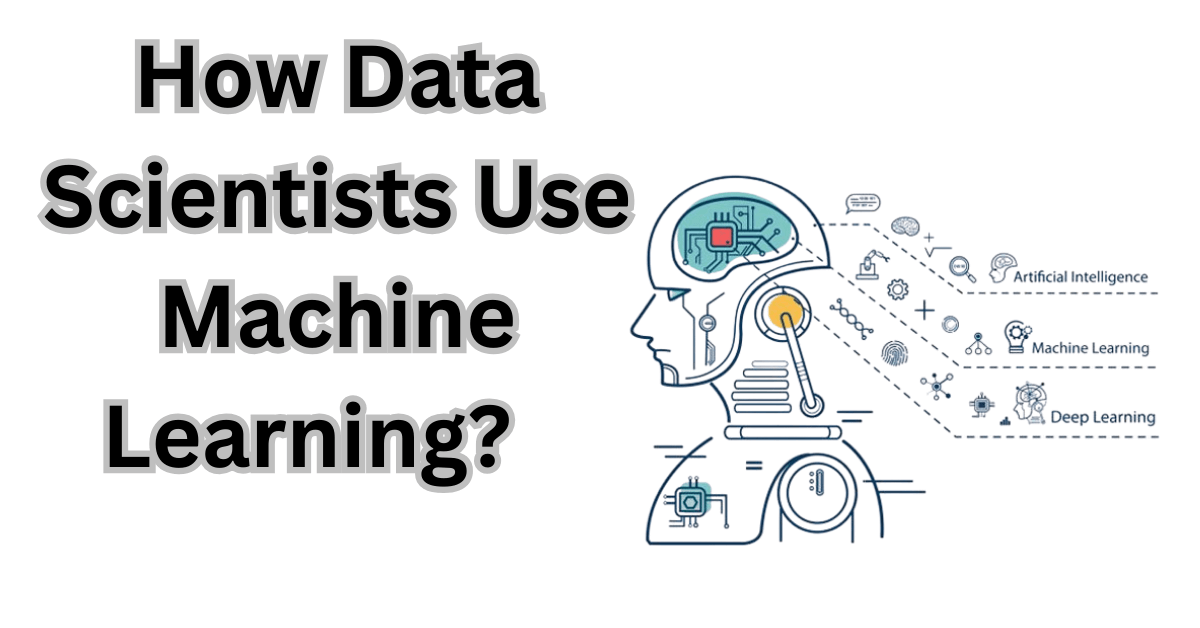
In data science, this evolution defines the modern role of machine learning. Without ML, data scientists would spend most of their time reviewing the data again and again for perfection. But they were not able to crunch numbers manually. With ML, they can build intelligent systems so fast that they learn, adapt, and improve over time. How they use ML in data science is given as:
1: Collecting & Cleaning the Data.
The first step that a data scientist uses in ML is data collection. This step of data collecting involves databases, APIs, logs, sensors, platforms, and surveys. But raw data is chaotic, and most of the time duplicate numbers, missing fields, and wrong formats.
Data scientists clean it and give it alignment. They remove errors and normalize the values. Handle missing entries and standardize the scales. If they skip this step, the model collapses before it even starts. Because all algorithms depend on huge levels of binary data, and when you feed the data with randomness, it considers it as garbage, and the results also come out as garbage.
This cleaning phase often consumes 60% to 80% of the data science workflow. But it pays enormous dividends. When you clean the data, it guarantees trustworthy predictions and accurate insights.
2: Selecting the Right Models for the Job.
Selecting the right model is really a big task. How a model fits the right datasets, it depends on the right skill you choose the right model that gives accurate results. It depends on data type, label availability, business goals, and computational resources. If the task predictions require supervised learning work, experts always suggest learning models that give results with accuracy. If the task needs hidden pattern discovery, unsupervised learning models are chosen.
For example:
The popular machine learning models include linear regression, logistic regression, decision trees, random forest, gradient boosting, and clustering models. Each model has a specific purpose and behaves differently. Some are fast but less accurate. Some are powerful but expensive. Data scientists compare, tune, and validate before final deployment.
3: Training & Testing ML Models.
Training involves feeding historical data into algorithms, so it learns patterns. Splitting datasets involves steps like training, validation, and testing. During training, the model adjusts parameters until it strengthens pattern recognition within the algorithm. After training, the testing phase judges whether the model generalizes or merely memorizes data.
Metrics such as accuracy, precision, recall, and F1-score help measure performance objectively.
4: Crafting Better Inputs through Feature Engineering.
Even the best algorithms fail with poor input features. That’s why data scientists perform feature engineering techniques to create meaningful variables. They transform categorical values. Create ratios. Normalize scales. Extract timestamps. Encode sentiment. Remove irrelevant columns. Sometimes, excellent feature engineering beats fancy algorithms. It uncovers hidden relationships and boosts model accuracy with surprising power.
5: Evaluating Models through Calculating Metrics.
Once trained, models need evaluation. Not all success looks the same. For fraud detection, recall matters more. For recommendations, ranking performance matters more. Evaluation metrics always demonstrate the real-world results. If models underperform, data scientists may retrain, tune hyperparameters, and try new algorithms.
6: Applying Deployment Makes Models Useful.
Models sitting in notebooks create zero value. Deployment puts them into applications, APIs, dashboards, or automation systems. But deployment is not the end. Models change the value of the variable because data changes over time. Continuous monitoring detects performance and protects the cost of purchase value for the new model. Retraining keeps systems accurate. This end-to-end loop defines true ML maturity.
How ML Solves the Real-World Problem:
- Forecasting & Predictions:
Forecasting and predictions are predictive analytics in business. Data scientists forecast sales, churn, demand, and supply easily. Business uses predictions to reduce uncertainty and plan smartly.
- Classification Tasks:
Machine learning easily categorizes the data into classes, such as which data indicates fraud datasets and which data indicates non-fraud datasets. It also makes categories of datasets and labels the variables for better understanding, like spam, non-spam, positive sentiments, and negative sentiments.
- Clustering and Segmentation:
Unsupervised learning models discover natural groupings. Companies segment customers’ demands according to their likes or dislikes. They also predict products that are high in demand and detect patterns of how humans miss something.
- Recommendation Engines:
In recommendation engines, streaming platforms, and e-commerce websites highly depend on collaborative filtering. They incorporate deep learning into actions. They easily suggest content and products that are in trend.
- NLP and Text Understanding:
NLP reads human language and drives sentiment analysis, chatbots, and document classification. It easily translates languages and understands the problems according to the situation.
6. Fraud Detection Task:
Banks detect fraud. Cybersecurity detects intrusions. Factories detect faulty sensors. Even small improvements save millions.
Challenges That Data Scientists Face:
Machine learning is not a silver bullet. Barriers include data scarcity, data bias, expensive labeling, black-box models, ethical concerns, and regulatory concerns. Explainable AI helps build trust. Ethical AI frameworks ensure fairness. But challenges will continue as ML evolves. These challenges that data scientists face and deal with such complexity to get accurate results through their skill sets. AutoML reduces manual workloads. Deep learning explores the new world with vision, speech, and generative creativity. Data scientists will remain at the center of attraction. ML will become more integrated, accessible, and automated.
FAQs:
1. What does a data scientist do with machine learning?
Data scientists use machine learning to analyze large datasets, build predictive models, automate decision-making, and support business strategies. Their work helps companies predict trends, understand customers, and reduce risk factors in a minute.
2. Which machine learning models are commonly used by data scientists?
The most commonly used models are linear regression, logistic regression, decision trees, and neural networks. The choice of the model depends on the data type and the problem being solved.
3. Why is data cleaning important before applying machine learning?
Before applying machine learning, data cleaning is important. Because everyone ensures accuracy in their results, machine learning models heavily rely on input quality. If the data contains bugs, missing value or inconsistencies, the model’s prediction quality drops as a result. Clean and structured data produces better performance and reliable results.
4. How do businesses benefit from machine learning in data science?
Businesses benefit through machine learning and improved forecasting, customer personalization, and fraud detection. Machine learning turns raw data into actionable insights, and in this way, it makes companies work faster and smarter to make decisions.
Conclusion:
Machine learning is really the beating heart of modern data science. It automates the tasks. extracts hidden patterns, and predicts future events with remarkable accuracy. Nowadays, how data scientists use machine learning determines a company’s innovation and how effectively they compete. From cleaning data to model deployment, the cycle involves critical steps such as feature engineering techniques, validation, and monitoring. Businesses benefit through personalization, optimization, forecasting, and fraud detection. As the challenges such as data bias, regulation, and model complexity still exist. But the momentum becomes unbeatable. With cloud-based platforms, smarter tooling, and democratized AI, the future looks bright and clear. Machine learning is not just an upgraded version. It is a revolution in motion, and data scientists are the pilots steering it forward.
Reference Links:
https://arxiv.org/abs/2101.03970
https://www.sciencedirect.com/science/article/pii/S1877050921002714
https://ieeexplore.ieee.org/abstract/document/8046093