Have you ever thought about how you get your favourite series in front of your screen, without typing its initials, or how weather applications predict the weather condition before the storm or rain comes? Behind these digital magic tricks, there exist powerful fields in artificial intelligence known as bold machine learning and bold deep learning. But when it comes to the hot debate of machine learning vs deep learning, most people confuse these topics like salt or sugar, which seem to be the same, but different in taste. So, we will unravel what machine learning is and what deep learning is. What role do they play in the tech world and how it produce miracles in boosting innovations nowadays?
What Is Machine Learning? – Explained well
Machine learning is a field of artificial intelligence where computers learn users’ patterns from their repetitive data without being manually programmed for each decision. Human efforts are less, but it is solely the complete training of computers to make them a decision-maker. Machine learning simply improves, optimises and adjusts the data with accuracy. When you feed a model with tons of input examples, the model starts producing prediction outputs.
For example, when you show them houses and prices, it learns to predict future housing prices accordingly. Similarly, when you feed emails as spam labels, it will flag junk mail like a seasoned bouncer at a nightclub.
Here is the kicker: machine learning often requires humans to extract useful features from data. Imagine detecting fraudulent transactions, a human expert has to decide what patterns might indicate fraud(e.g., time of purchase, amount, frequency). The model learns from those features, but humans give it the blueprint.
Types of Machine Learning:
There are different types of machine learning algorithms:
Supervised machine learning: In supervised learning, the model learns from labelled datasets and generates the output simultaneously. For example: Spam detection and price prediction.
Unsupervised machine learning: In unsupervised learning, the model learns patterns without labels and generates the output according to the facts and figures. For example: Customer grouping and anomaly detection.
Reinforcement machine learning: In reinforcement learning, the model learns through rewards/bonuses and calculates the commission percentage vice versa. No need of manually command required there. For example: Robotics and game bots.
Applications of Machine learning:
There are different applications of machine learning that not only help the tech world but also are a source of innovations:
Fraud Detection:
To detect fraud in banks, fintech apps, and payment processors, we use machine learning algorithms everywhere. Models learn from historical fraud data and instantly flag risky activity. This process speeds up the investigation techniques.
Recommendation systems:
All social platforms like YouTube, Instagram, Amazon, and Netflix rely on machine learning to experience user behaviour. It also suggests personalized content or products according to their activity time. These systems learn preferences over time. Skyrockets the engagements and increases the sales eventually.
Healthcare diagnosis and treatment:
Machine Learning models empower doctors so that they can easily examine the medical reports through X-rays or MRIs. Disease recognitions become easy when you adapt the latest tech in your software. It also reduces patient risks and recommends treatment plans. Early cancer detection tools are used in hospitals. Pathology analysis relies heavily on machine learning.
Predictive Balancing:
Manufacturing of sensor devices and the aviation industries incorporate machine learning to predict equipment failure before it happens. By analyzing sensor data, machine learning reduces downtime of the machinery process, prevents accidents and saves millions in repair costs.
Natural language processing (NLP):
It is a tool that uses machine learning technologies that manipulate, easily understand and generate human language.
For example:
- Chatbots.
- Spam filters.
- Speech-to-text systems.
- Language translation.
- Virtual Assistants.
What Is Deep Learning?
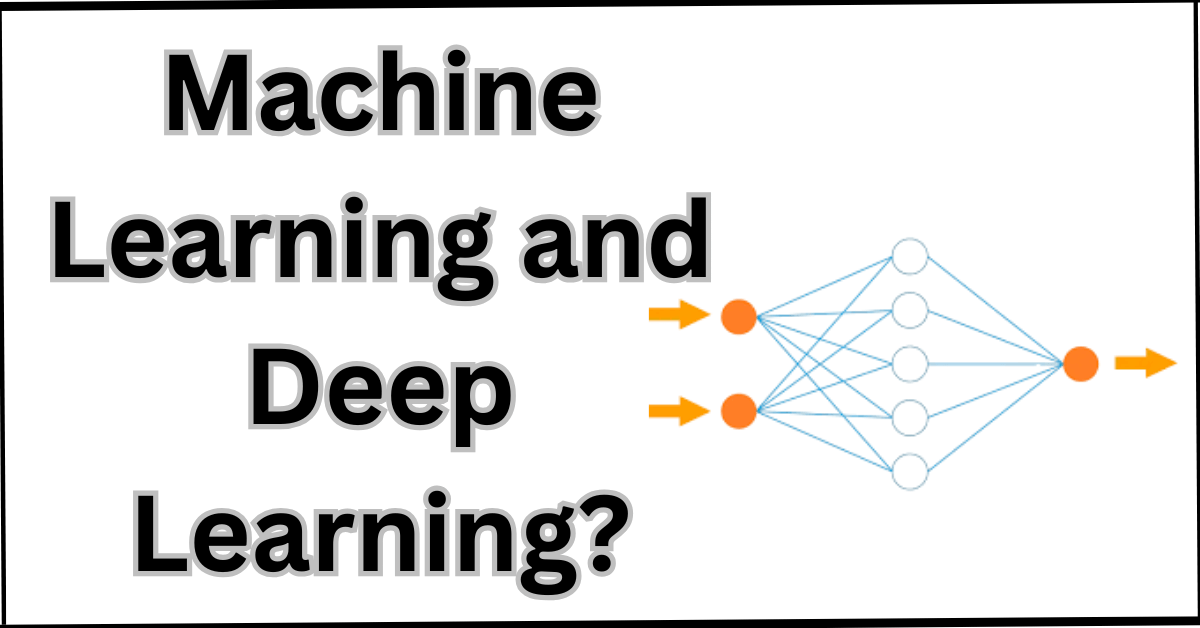
Deep learning is basically defined as a system of artificial neural networks that are formed with multiple hidden layers that can automatically learn from raw data easily. Most of the time, deep learning is used in image recognition, natural language processing, and speech recognition.
It does not require humans to hand-craft features. If you add up a million images, it figures out images, edges, shapes, textures, and objects all by itself. In fact, it is also beating industries like robotics used in self-driving cars or chatbots.
Types of Deep Learning:
There are different types of deep learning that are used in various architectures, for performing different tasks:
- Convolutional neural networks: It is used in face recognition processing tasks that compare the image with the user’s identity; they easily it tells out their features match or not. CNNs are designed to adapt spatial hierarchies of features through convolutional layers.
- Recurrent neural networks: RNNs are used where data needs to be in sequential form. It has different loops that allow information to persist and identify speech and language in a model.
- Long and short-term memory Networks: It is a type of RNN, which indicates the gradient problem in a model. It is used for complex sequences that produce voice-over speeches and scripts in a minute.
- Generative Adversarial Networks: GANs consist of two neural networks that discriminate and produce synthetic data, like image creations.
For example, when we give a command to a software to create an avatar or a character for a movie, we use GANs for this purpose in a model - Transformers: It is used in deep learning to handle long-range data. They are the heart of GPT and BERT, used in NLP.
Application of Deep learning:
There are vast applications of deep learning in the tech world, as given below:
- Self-Driving Car: Deep learning enables autonomous vehicles to detect the object infront of them, recognize traffic signs and make driving decisions. Model process camera feeds and lidar data to ensure real-time navigation.
- Facial recognition: Deep Learning identifies and verifies faces under different angles, lightning or partial occlusions.
- Medical Image Analysis: Deep Learning help radiologist detect diseases like cancer, brain tumours from MRIs, CT and X-rays. These systems help in matching or recognizing early human diseases.
Difference Between Machine Learning and Deep Learning:
| Basis | Machine Learning | Deep Learning |
| Definition | ML is an algorithm that learn from data and improves by putting more and more datasets. | DL is a set of multi-layer neural networks. |
| Data requirement | It is used for datasets that are in sequential form with a small and limited range. | It is used for datasets that are in bulk and consist of random data. |
| Training time | It requires less time. | It usually needs more time for all computational activities. |
| Accuracy | It depends upon quality of the device on which you are working. | DL gives more accurate data. |
| interpretability | Easy to apply to any system. | Difficult to apply to any system. It is system-specific. |
| Examples |
|
|
FAQ’S:
Why do data analysts use machine learning?
Machine learning is a subfield of data science. These are the fundamental subjects of interest for them because they hold the core concepts of them. That’s why they use it to manipulate the datasets easily.
Can I learn machine learning quickly?
Machine learning is a field of innovation, and its concepts need a phase of continuous learning. Depending on your background subjects, you can learn it in a month, or it may also take a year to grab its full concept thoroughly.
Is deep learning tough for any non-background student?
Yes, it is possible for every student whose background did not match computer science. Deep learning and machine learning are tough at first due to their complex mathematical nature. But when you divide the whole syllabus and make a schedule of it, commit to fulfilling it little by little, daily. Your impossible becomes possible.
What is the difference between a neural network and deep learning?
Neural networks are the node layers that make input layer, output layer, or hidden layers within the machine systems, but deep learning is the set of multi-layered neural systems that automatically learned from raw datasets.
Why are neural networks mimicking neurons?
Neural networks are also called simulated neural networks because it ia s subset of machine learning, and deep learning is the backbone of it. They are called neurals because they mimic neurons of the brain that signal messages in the body same as layers transmit data in the system.
Conclusion:
In a nutshell, the whole debate of machine learning vs deep learning enables you to determine which one is the best fit for you when you have limited or random datasets. Machine learning thrives when data is structured, limited and needs quick training with human-crafted features. Deep learning shines like a diamond when it is flooded with massive datasets and consists of complex patterns like facial recognition, self-driving cars, and medical imaging.ML plays by the rules, but deep learning is the powerhouse that bends the rules with multi-layered neural networks. One requires careful feature engineering, and the other is a totally complex black box. If you really need precision or power, picking the right tool is the right job.
Reference link:
https://ieeexplore.ieee.org/abstract/document/8259629
https://link.springer.com/article/10.1007/s11030-021-10217-3