You have probably heard it everywhere that AI is changing the game. Trends are shifting very quickly just through a single click, and results are coming to you within seconds. From chatbots to self-automated industries, deep learning is the engine behind today’s smartest technology.
The real question at this point is, what is the starting point if you want to pursue this profession? Feeling overwhelmed, right? You are not alone. You do not need to be a genius or have a PHD degree in your hand to break this field. What you need is clarity, direction, and consistency.
This deep learning roadmap for beginners in 2026 is designed to give you a clear map you can follow step by step, whether you are a student or a career switcher. This guide helps you cut through the noise.
.
The Powerful Impact of Deep Learning in 2026.
In 2026, deep learning is not a buzzword; it is the backbone of artificial intelligence. Companies across healthcare, finance, e-commerce, cybersecurity and robotics rely heavily on deep neural networks. When you learn deep learning, you are not just learning theory. You are learning how machines actually work to recognise images, translate languages, generate human-like text, detect fraud, and drive cars autonomously.
The demand for skilled professionals is rising steadily. If you position yourself correctly, you can ride the wave instead of playing catch-up later.
Why Do You Need a Footprint?
When a newbie starts this profession, he becomes totally lost and hardly find any way. There are many models, libraries, video and maths topics with no clear order. A proper deep learning roadmap organises what to learn step by step so you build solid fundamentals.
You are able to tackle CNNs, RNNs, transformers, and deployment in a logical progression. This deep learning roadmap 2026 focuses on doing projects at each step, so you do not get stuck in a theoretical story. You move the needle easily from simple neural network modules to real-world applications while learning the same tools that professionals use.
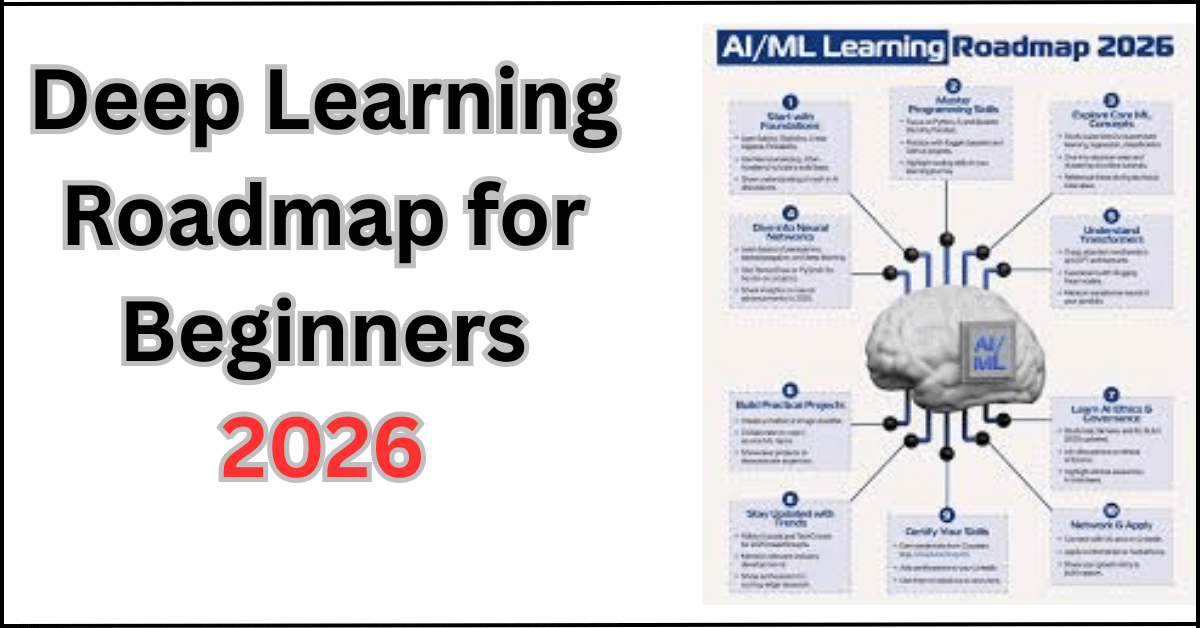
Complete Deep Learning Roadmap 2026 (From beginner level to advanced level )
This structured roadmap consists of 10 modules from months 1 to 10. You can understand the concept and importance of each module easily. But the order of modules builds a strong foundation before advanced models and MLops even start.
Each module includes concepts, tools, and mini projects for a lot of practice to become an expert.. By the end, you will have a portfolio that covers CNNs, RNNs or LSTMs, transformers, generative models, and at least one deployed deep learning system.
Module 1: Maths and Programming Foundations. (Month 0 to 1 )
In module 1, you focus on core skills that build your foundations of deep learning work. You learn programming basics, such as starting from a very basic language like Python. In this duration, you learn variables, control flow, functions, modules, and simple debugging. In the parallel row, you revise linear algebra topics like vectors, matrices, and dot products, which are used in layers and embeddings.
You also learn calculus fundamentals such as derivatives, gradients, basic probability and statistics to understand loss and uncertainty. Side by side, you also learn Python, NumPy, Pandas, and Matplotlib, with mini projects like matrix operations and small data visualisation tasks to build the arrays and plots to do the tasks easily on repetition.
Module 2: Machine Learning Basics (Month 1–2)
This module tells and empowers you to use traditional machine learning so you can understand the general modelling workflow before you move to an advanced level. You study supervised and unsupervised learning. These concepts train to like test splits, overfitting, underfitting, regularisation, and how to deploy the models properly.
By using scikit learn, you implement simple classification models, such as logistic regression or decision trees and regression models, such as linear regression. There are mini projects also available in which you learn to predict house prices and build a small classifier on tabular data, which teaches you data preprocessing, feature scaling, and basic evaluation.
Module 3: Deep Learning Foundations (Month 2–3)
In module 3, you learn core deep learning ideas. You learn neural networks, perceptrons and feedforward networks. You also learn activation functions like ReLU, sigmoid, and tanh shape model behaviour. You study loss functions such as mean squared error and cross-entropy.
You begin using frameworks like TensorFlow and PyTorch to build a basic neural network
Module 4: Convolutional neural networks (Month 3–4)
In module 4, you learn CNNs, which are the basics of computer vision tasks. You easily learn convolution, kernels, feature maps, pooling, padding, and the receptive fields.
Projects in this phase include image classification on datasets like CIFAR10 or MNISt using CNNs and built-in layers from Pytorch or TensorFlow. You easily edit image augmentation and try transfer learning by fine-tuning a pretrained CNN on a customised image dataset.
Module 5: Learn the basics of RNNs, LSTMs, and GRUs (Months 4–5)
In module 5, you handle hands-on experience with sequence models for time series and text. You learn how recurrent neural networks process comes to play and how vanishing gradients led to improved units like LSTMs and GRUs. You learn hidden states and sequence models here.
In this module, you build simple text generation models that predict the next character or word. You also practice basic time series forecasting, where an LSTM predicts future outcomes from past activities.
Module 6: Transformers and Modern Deep Learning (Months 5–6)
Module 6, it introduces you to transformers, which are the backbone of modern AI systems. You easily handle attention mechanism, self mechanism and how transformers replace recurrence with parallel processing. This roadmap covers key transformer families like BERT and GPT for NLP for image tasks.
You use Hugging Face Transformers to load the models for deployment and fine-tune them for tasks like answering questions and summarisation. You can experiment with image classification using hybrid models. These projects help you to understand why a deep learning roadmap is crucial.
Module 7: Generative models (Month 6–7)
In module 7, you explore models that generate new data on the basis of previous data. You hit up first with autoencoders. Learn a skill where you understand how encoders compress data into latent vectors, and decoders reconstruct it. Then, after this, you learn variational autoencoders, where you learn latent space probability and GANs.
You also learn about diffusion models to high quality image generation. Projects include image generation with GANs, image diffusion experiments, and autoencoder-based error detection.
Module 8: Optimisation, Training, and Scaling (Months 7–8).
In module 8, it deepens your understanding of how to train models efficiently. You study optimisation algorithms like SGD, Adam, and RMSProp. You also learn rate schedules such as step decay, cosine annealing or warm restarts. In this duration, you also learn regularisation methods, including dropout, batch normalisation, weight decay, and data augmentation to control the data from overfitting.
You also learn to control hyperparameter tuning using tools like Weights and Biases. Projects in this phase are usually model tuning challenges where you try different architectures, learning rates and regularisation strategies. It helps you further deal with training curves and validation metrics.
Module 9: Deployment, MLOps, and GPU training (Months 8–9)
In module 9, you focus on turning your deep learning models into usable services. You learn about exporting models to ONNX, then optimising them to TensorRT. You practice quantisation to reduce memory and speed up inference. You also study how to use GPUs effectively, including batching and mixed precision training in PyTorch or TensorFlow.
Next to this, you go to the MLOps side, where you build FastAPI-based model APIs. Customise them with Docker. Set up basic monitoring for latency and errors. Projects in this phase deploy deep learning models that run behind a REST endpoint. For example: image or text classification in web applications.
Module 10: Portfolio, Resume, and Interview Preparation.
This model displays your work for publication and polishes your results with great achievement. A strong portfolio for deep learning 2026 includes one solid CNN project, an RNN or LSTM-based sequence project, a transformer-based model, and at least one deployed model. Each model includes clean code and a short explanation of data, model decisions, and results.
You can add an object detection app, an LLM-based chatbot, and an AI content generator. In the parallel row, you can practice common interview questions. Design systems for ML and proper storytelling about your learning journey, and you ace the job.
FAQ’s:
How long does it take to learn Deep Learning?
Deep learning takes 1 to 3 years to become a professional who has a strong grip on skillsets. But foundational learning can be achieved within 3 to 6 months.
Do you need strong math skills for Deep Learning?
You do not need to become a mathematician, but you need a solid foundational understanding of specific maths to effectively build, debug, and optimise deep learning models.
Which framework should you start with, TensorFlow or PyTorch?
Depending upon your goals, you go with TensorFlow or PyTorch. If your goal is to deploy the models on a large scale, you should go with TensorFlow. But if your goal is to prioritise research and rapid prototyping, then you should go with PyTorch.
Conclusion:
Deep learning in 2026 is not a trending skill, but in fact, it is a career-defining opportunity. If you follow this roadmap step by step, you will not feel lost. You build knowledge layer by layer, starting from programming skills to portfolio building, and you always equip yourself with experience. By the end of the journey, you will have a strong portfolio, practical experience, and the confidence to apply for internships.
Reference Link:
https://link.springer.com/article/10.1007/s00530-020-00694-1
https://link.springer.com/chapter/10.1007/978-1-4899-7641-3_12
https://link.springer.com/chapter/10.1007/978-3-030-36841-8_20