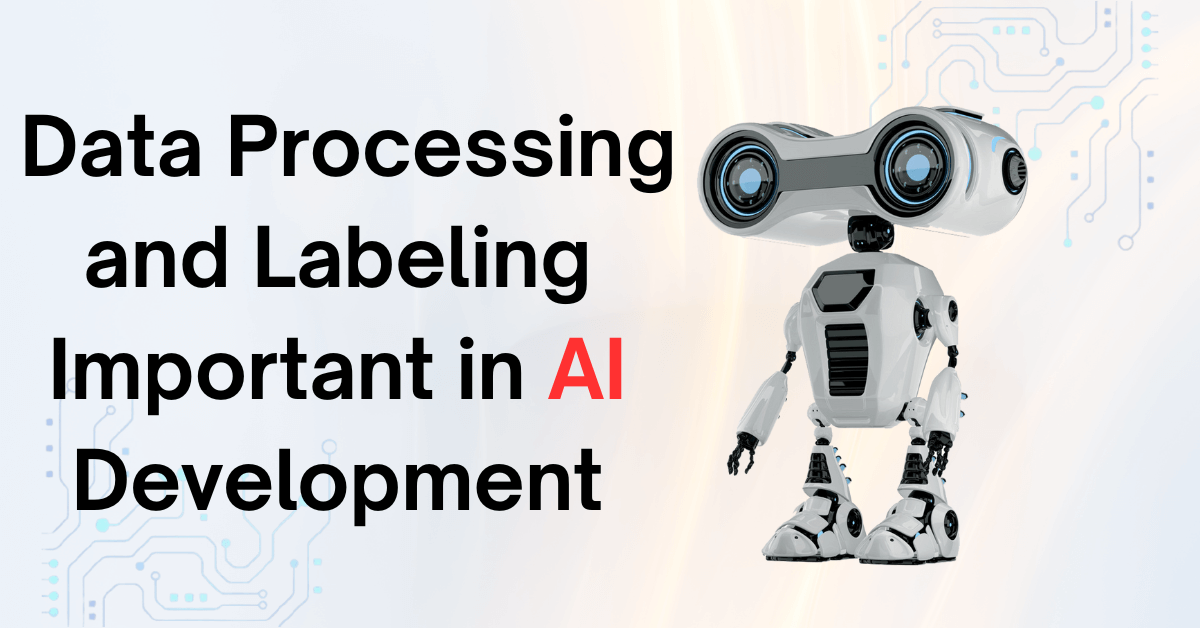
And here’s where all the magic happens: on this sweet ingredient, the data. The world is turning from self-driving cars to chatbots very quickly. But all these marvelous intelligent systems were built on one thing: data. Now, for artificial intelligence to work well, the data must be pre-processed and properly labeled; otherwise, the models will give very poor performance and results with dirty data that has not been labeled.
We will discuss the importance of data processing and annotation in terms of how it contributes to AI development. Other terms that will be touched on include data annotation, preprocessing, and training AI using labeled data.
Importance of Labeled Data in Machine Learning
Since labeled data forms the basis of machine learning, AI requires examples of its operation to learn both how it is meant to model patterns and predict the value.
What is the labeled data?
Labeled data IS the data that come with tags. For instance, an image of a dog labeled “dog” serves as an example of how AI learns about what a cat look like.
Why is this important?
Raw data have no meaning for machine learning algorithms; with labels, the raw data hold context, which makes the raw data meaningful within the frame of training models.
Example:
If you want an AI agent to know how to detect spam mail, you will have to label each email coming into your database as either “spam” or “not spam,” and the AI will learn from these examples.
Otherwise, with no labeled data, the model would guess without any standard, producing extremely low-level accuracy.
Data Annotation in AI
Data annotation is the process of adding labels or tags to raw data. It makes the information usable for AI models.
Common Types of Data Annotation
- Image annotation: Tagging objects in pictures (e.g., dog, car, tree).
- Text annotation: Marking emotions in text (e.g., happy, sad).
- Audio annotation: Adding tags for sounds (e.g., music, laughter).
- Video annotation: Labeling actions or movements in video frames.
Why It Matters
Data annotation in AI ensures accuracy. A self-driving car can only recognize a stop sign if its training data was properly annotated. If not, it risks accidents.
Role of Data Preprocessing in AI
Raw data is messy. It may contain errors, missing values, or noise. This is where data preprocessing comes in.
Key Steps in Preprocessing
- Cleaning data – Removing duplicates, errors, and irrelevant details.
- Normalizing data – Bringing all values into a standard format.
- Handling missing data – Filling gaps with average values or removing incomplete records.
- Feature extraction – Selecting important details that improve model performance.
Why Preprocessing is Important
Quality data for training is what role data preprocessing takes on AI as it prepares this data. If the data turns out to be dirty or unclean, the AI would learn the wrong thing. Hence, accurate and reliable results come out of cleaning the data.
Train an AI Model with Labeled Data
Like a child learning through example, training AI systems with labeled data is a clear and precise examples that better “teach” the AI; the better the examples, the clearer the model’s learning.
Supervised learning: Models are being trained using a labeled dataset. For example, teaching AI to recognize animals using labeled photographs.
The Prediction Accuracy: More labeled data means more accurate and valid predictions.
Real-world application: Labeled medical images help AI detect diseases like cancer with high accuracy.
Challenges in Training with Labeled Data
- Requires humongous amounts of data.
- Manual labeling is time-consuming.
- Pricey, especially when using expert labeling (similar to healthcare).
Benefits of Data Processing and Labeling in AI Development
These include many benefits.
Increased accuracy: A pure, labeled data set improves reliability.
Improved Prediction: Models can read the patterns.
Lesser Errors: Preprocessing removes noise and mistakes.
Save Time: Well-structured save training time.
Real-world usability: AI systems become practical for healthcare, finance, retail, and more.
What Happens Without Proper Data Processing and Labeling?
If AI is trained with poorly labeled or unprocessed data, problems occur:
- Wrong predictions.
- Unfair or biased outcomes.
- Higher risk of errors
- User distrust in AI systems.
For example, if a medical AI system is trained on mislabeled data, it will not detect diseases correctly. This lead to serious complications.
Future of Data Processing and Labeling in AI
As AI grows, the need for quality data will only increase. New technologies are making labeling faster with tools like:
- Semi-supervised learning: Uses some labeled data and a lot of unlabeled data.
- Active learning: AI helps select which data needs labeling.
- Automation tools: Reduce manual effort in annotation.
Conclusion
Why are data processing and labeling important in AI development? Because no AI can learn appropriately without it. With data annotation, AI, preprocessing, and labeled training examples, we make machine learning possible. What else could be there? Medical diagnosis and understanding of humanly identifiable information; labeled data is what makes machine learning work! Clean, labeled, and preprocessed data powers AI systems with fairness and accuracy.
In simple terms: Better data means better AI.
FAQs
1. Why is data processing and labeling important in AI?
It becomes clean and meaningful with processing and labeling. It can learn correctly with the right preparation and labeling of data. Otherwise, models yield results that are wrong or unfair.
2. What is AI in data processing?
Data processing denotes support by Artificial Intelligence in faster cleaning, organizing, and preparing information with errors removed and missing values filled, while useful patterns are derived. This is further useful while developing accurate AI models.
3. What is labelling in AI?
Labeling in AI means assigning a category or tag to a given dataset so that the machine understands it; labeling an image as a “dog” or “cat.” Labels help the AI learn patterns and predict outcomes.
REFERENCE:
https://ojs.aaai.org/index.php/AAAI/article/view/21714