What is the difference between the terms Computer Vision and Image Recognition?

Image recognition and computer vision are really confusing when you deal with AI and data science. They are always considered as two peas in a pod; in fact, they are not. The computer field is a broader field, but image recognition is part of this field. Both of these fields deal with visual characteristics, which is why these terms are most often used alternatively.
Due to their similarities, both computer vision and image recognition represent different technologies and applications. In this article, we compare computer vision & image recognition differences, similarities, and how they create wonders in the AI world.
What is computer vision?
In computer vision, computers or machines are trained to a high level of understanding from the input digital images or videos for the purpose of performing automatic tasks that display human-like visualizations on the console. It consists of many image processing techniques.
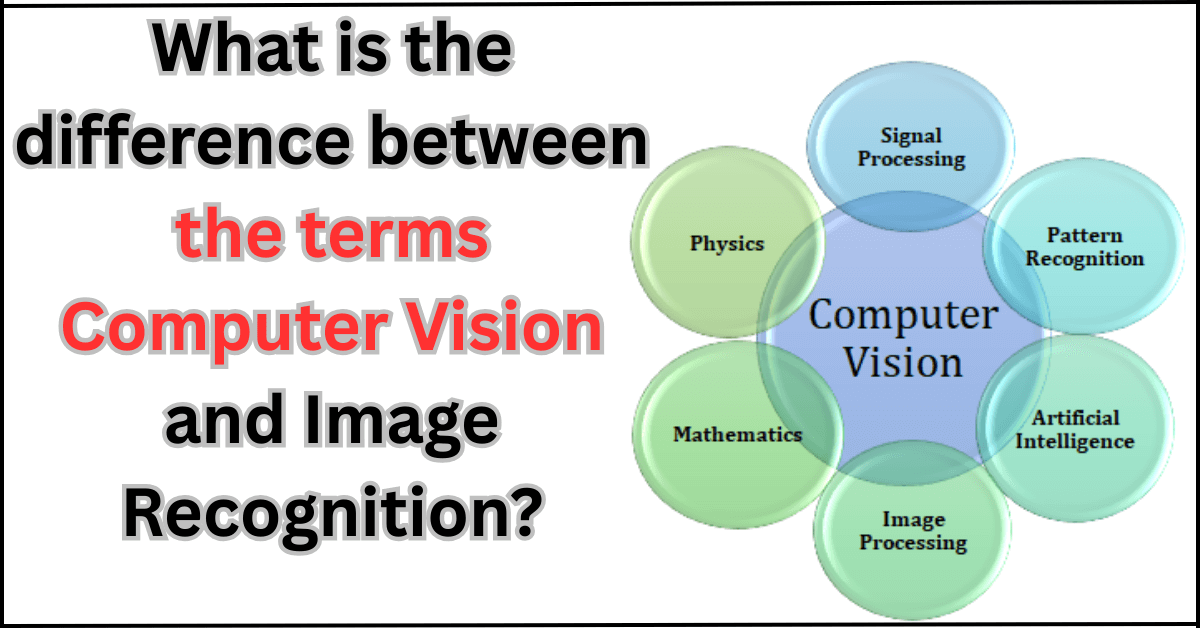
Computer vision models perform analysis to recognize images or classify objects within images, and also remove objects.The motto of a computer vision model is always more than just detecting the object within an image.
For example:
A computer vision model also identifies any image object selected as it is a dog or a cat. It is a flower, or it is a human being.
How Computer Vision Creates Wonder in the AI World? Step-by-Step Guidelines:
The algorithm of computer vision is similar to the algorithm of image recognition. But most importantly, it structurally recognizes the image object and notes the details pixel by pixel. It follows the pipeline sequentially to see the process and understand the images or videos. Here is how it creates wonder:
Image Acquisition:
The system captures images or videos through cameras, sensors, or datasets. This is the initial step that computer vision algorithms take. They do not have any input or visionary command. They just accumulate the data.
Pre-Processing:
The image is cleaned and enhanced by an algorithm. This process includes resizing, noise removal, conversion, and normalization to improve quality.
Feature Extraction:
The system identifies the recognition patterns such as image edges, textures, shapes, and colors. As compared to deep learning, convolutional neural networks (CNNs) automatically learn these features.
Model training:
Algorithms are trained enough to label the datasets to recognize the patterns. Frameworks like OpenCV, TensorFlow, or PyTorch are used to train the model and adjust the results accordingly.
Detecting the objects:
The models are trained to identify objects by understanding each pixel. So, you can say that the model is pixelated enough to study every minor detail. An algorithm can easily learn whether the object is moving or is at rest.
Decision making:
After going through all the steps, the system finally takes action. The resulting action tells you that you are going to unlock the phone, detect any fraud, or guide a self-driving car.
What is image recognition?
Image recognition is a subfield of artificial intelligence that enables computers to identify objects in digital images by recognizing their patterns. Image recognition trains the computer’s ability to identify objects as human or animal.
The main purpose of using image recognition is image classification. The algorithm automatically predefined the labels and categories after performing the analysis. It interprets the visual content to learn meaningful information.
For instance, when you incorporate the image into the algorithm, the image recognition automatically identifies and labels the dog or cat in the image.
How Image Recognition Creates Wonder in the AI World? Step-by-Step Guideline:
Image recognition has a different way to study the images. It firstly break down the image, studies patterns, and makes an educated analysis based on its previous record. How does it break down the procedures? It is given below:
- Converting Images into Data:
When an image is uploaded into the algorithm, it is converted into numerical pixel values. Every image is basically a grid of numbers represents its colour intensity and tonality.
- Cleaning and Preparing the Image:
After converting images into data, the system does the work of furnishing the data. It automatically resizes the image and adjusts the brightness. So, the model did not get confused.
- Feature Learning:
Feature learning is always performed using modern systems such as Convolutional Neural Networks (CNNs) to automatically detect geometric parameters. Instead of doing things manually, the network learns what matters most.
- Training the Model on Labeled Data:
The model studies thousands of labeled examples. For example, it distinguishes the selected algorithm, which learns to detect whether the selected object is a cat or a dog, by repeatedly comparing features. For training purposes, tools such as TensorFlow and PyTorch are widely used.
- Model makes Predictions:
When a new image is uploaded into the system algorithm, the model compares it to what it has learned during its training. It automatically assigns a label to attain the accuracy score.
Distinguish between image recognition and computer vision?
| Basis of distinguish | Image Recognition | Computer Vision |
| Definition | A subfield of AI that identifies and classifies objects in an image. | It is a field of AI that enables machines to interpret and understand the visual data from images and videos. |
| Scope | Narrow and specific. | Broad. |
| Main goal | To answer: “What is in this image?” | To answer: “What is happening in this visual scene?” |
| Functinality | Focuses mainly on labeling and classification. | Includes recognition, detection, tracking, segmentation, and scene analysis. |
| Complexity | Less complex compared to full vision systems. | More complex because it involves multiple tasks and deeper analysis. |
| Output | A label or category (e.g., cat, car, tumor). | Decisions, measurements, tracking data, scene understanding. |
| Example | Identifying a dog or a cat in a photo. | It automatically detects the faces, tracks the movement, estimates the distance, and analyzes the expressions. |
FAQ’s:
From which field does image recognition belong?
Image recognition is a field of artificial intelligence. It has a noticeable effect in the advancement of the tech world.
Which field do you find toughest: computer vision or image recognition?
Computer vision is also a harder and more complex field than image recognition. Because it includes multiple tasks like detection, tracking, and segmentation.
Can beginners also opt for the field of computer vision?
Yes, beginners can also opt for the field of computer vision projects, such as simple image classification or face detection, before moving on to advanced systems.
Conclusion:
The broader field you can easily identify from the article is the computer vision scope. That covers all the AI advancements in them. It easily performs analysis and understands the visual data. But image recognition is just one oriented field that identifies objects based on their feature specifications.
Reference Link:
https://onlinelibrary.wiley.com/doi/full/10.1155/2018/7068349